Open-ended evolution in artificial life is typically driven by uninterpretable, black-box neural-network complexity metrics, leaving life-like systems disconnected from physical theories of complexity. We introduce MSPD (Multi-Scale Path Divergence, $D_P$) — a renormalization-group-inspired scalar that quantifies the temporal multiscale organization of heterogeneity in local transition laws. MSPD is an explicit formula that plays a dual role: as a gradient-free fitness function and as a post-hoc analytical lens on any simulation that exposes local transition laws.
Three claims, retained for this version of the paper:
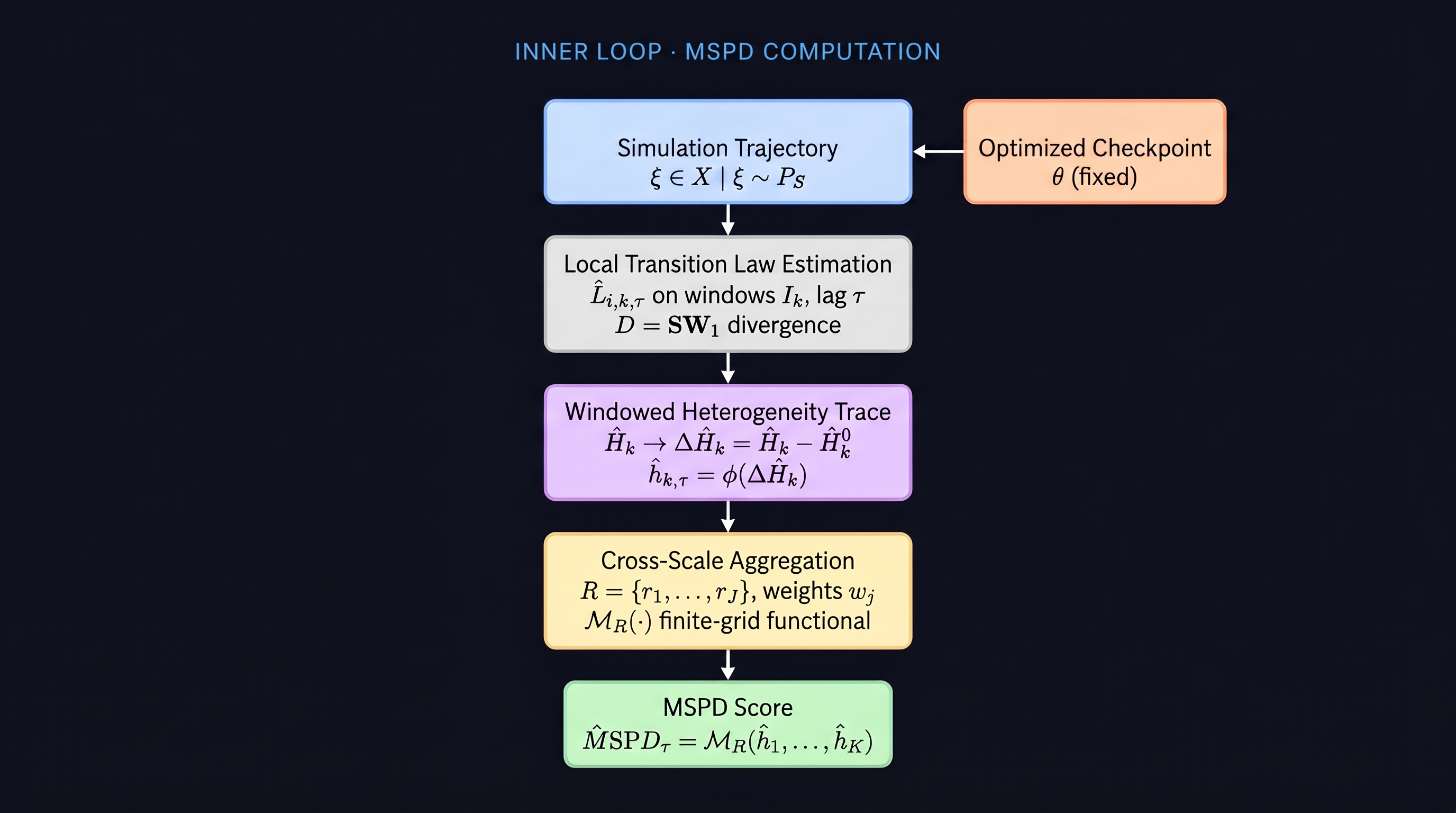
Open-ended evolution is a two-loop setup. An inner loop applies a fixed rule $\theta$ to states, generating a trajectory. An outer loop rescores the trajectory with some scalar — the "compass" — and mutates $\theta$. The compass is the bottleneck of the field: today, it's typically a neural network (ASAL, Leniabreeder), with no link to physical theories of complexity. MSPD is an explicit, RG-grounded alternative.
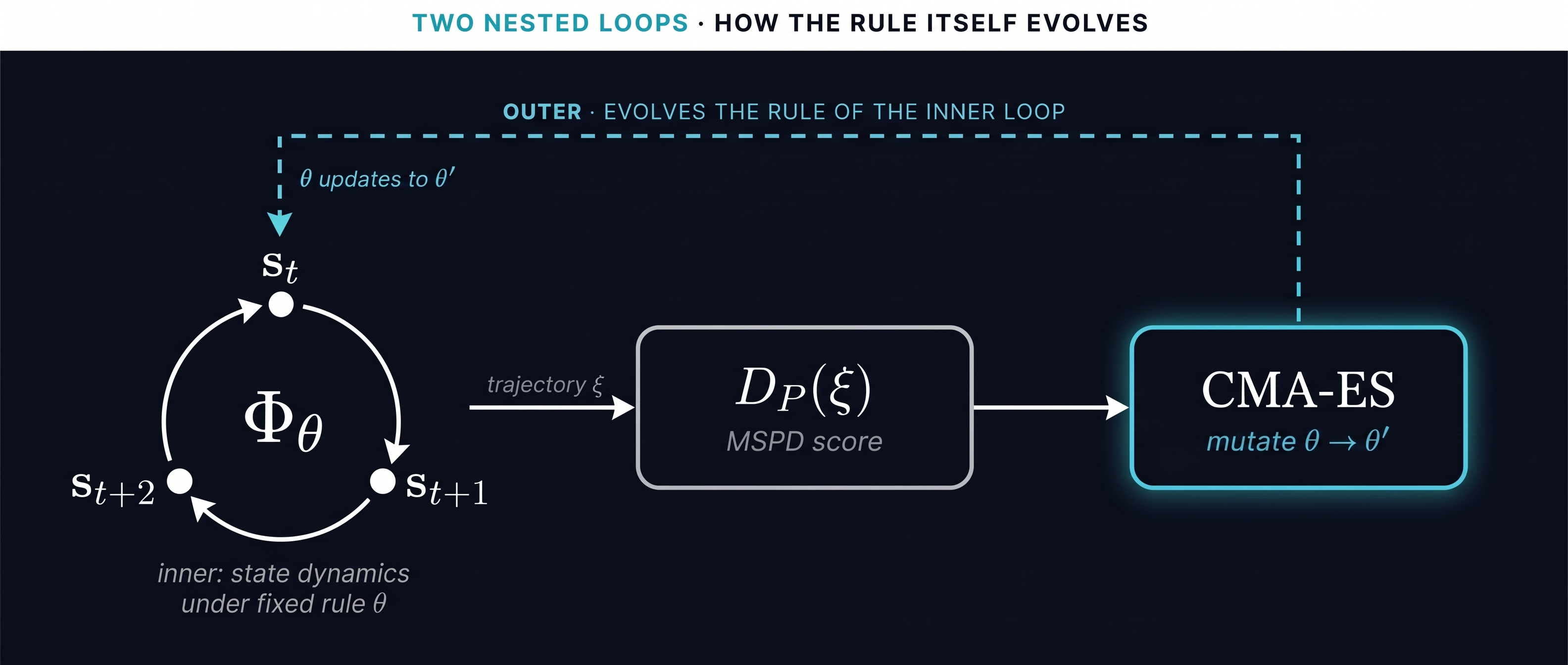
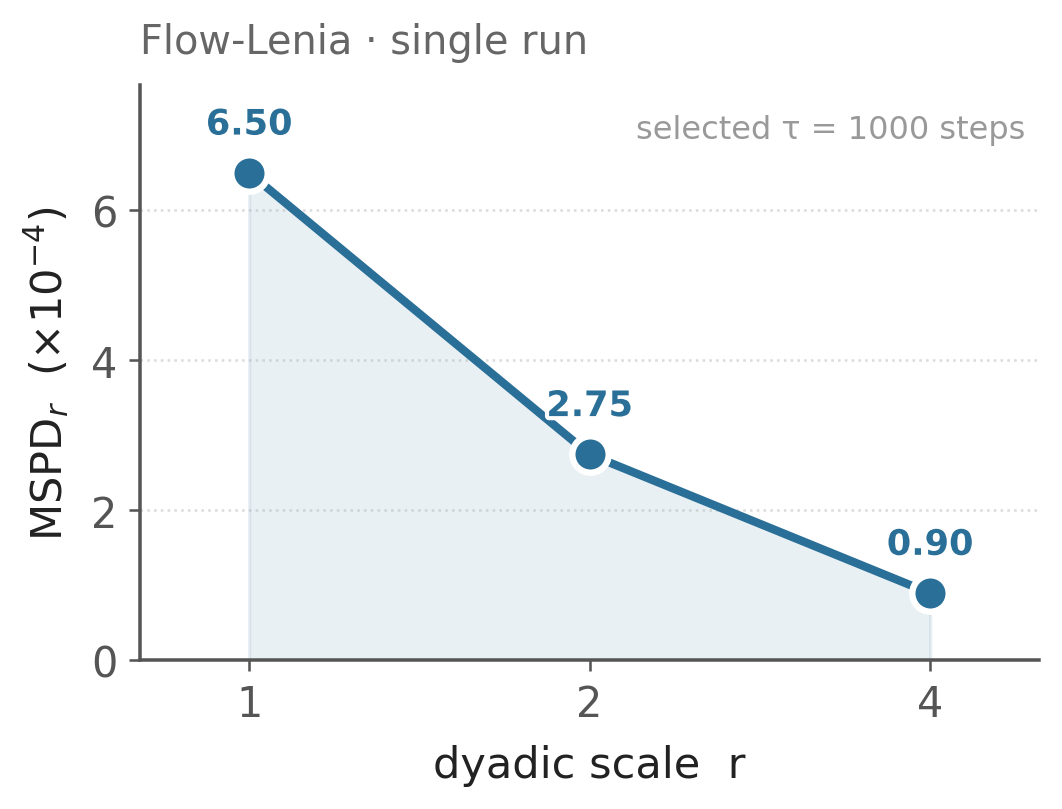
MSPD is a temporal extension of spatial Multi-Scale Structural Complexity (Bagrov et al. 2020). The RG architecture is inherited intact: the spatial coarse-graining scale $\lambda$ is replaced by an observation window $W$ on time, and cross-scale dissimilarity is computed in trajectory-distribution space rather than image space.
where the heterogeneity trace $h$ measures, at every state $x$ along the trajectory, the average pairwise divergence between local transition laws at sites $i$ and $j$:
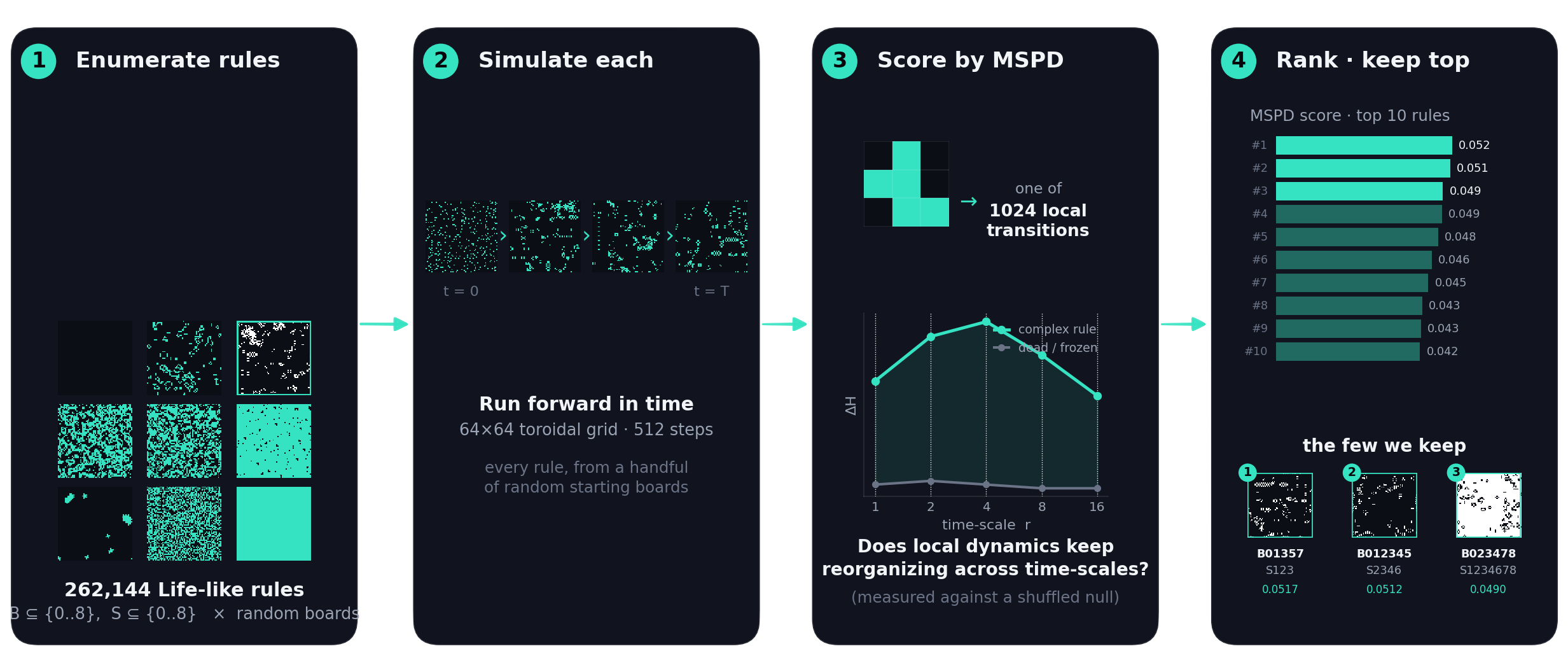
For each substrate, the outer loop walks a different rule space. Life-like cellular automata are small enough to enumerate exhaustively — every one of the 218 totalistic rules is scored by MSPD on the same evaluation budget. For Flow-Lenia and Particle Life++ the rule space is continuous; we replace enumeration with Sep-CMA-ES, a gradient-free evolutionary optimizer, but the four-step recipe below is otherwise identical.
On Particle Life++, MSPD-optimized parameters produce higher held-out scores than matched random parameters from the same substrate: 7/7 matched groups positive, p = 0.008. Confirmed on Life-like CA by exhaustive rule sweep. Directional but underpowered on Flow-Lenia (6/9, p = 0.25) under the current optimization budget.
Sanity check: on synthetic controls, $D_P$ is zero for white noise, zero for a single drifting blob, and low for stationary role mixtures — it measures temporally organized heterogeneity, not motion magnitude or visual novelty.
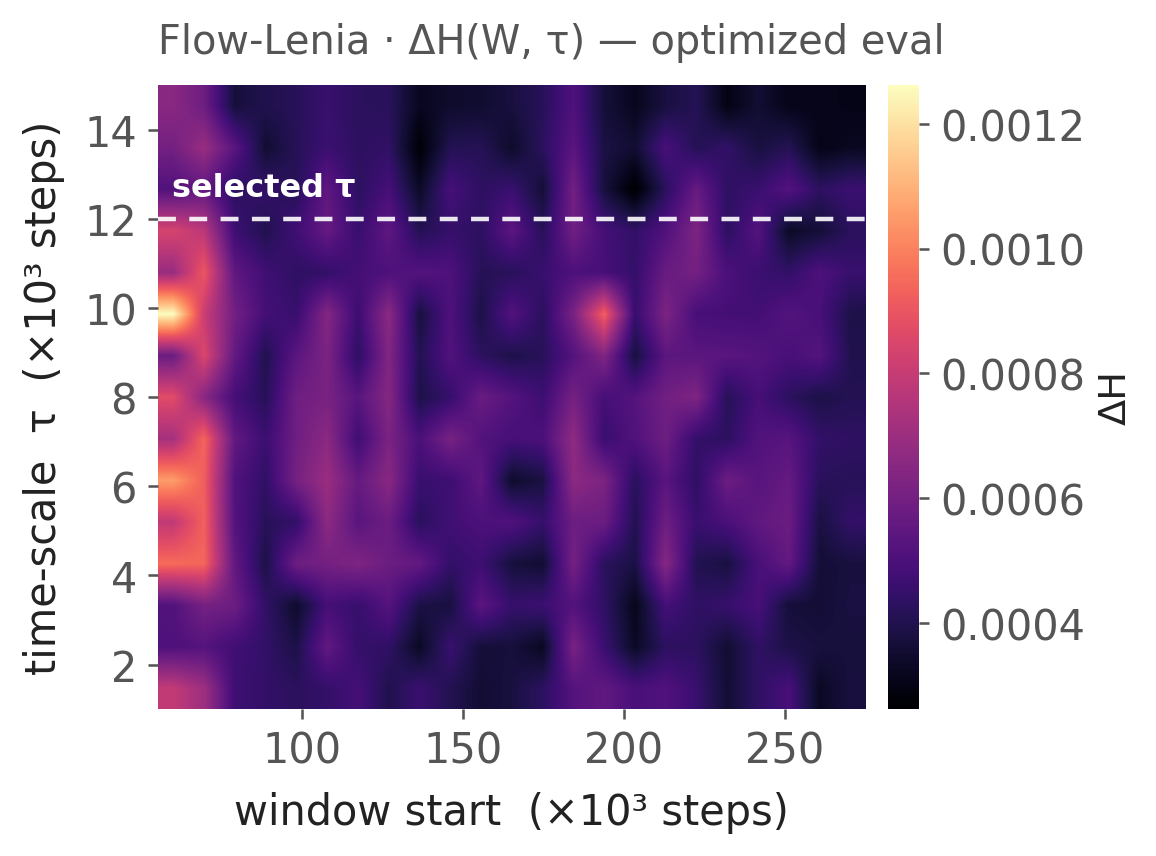
A locally elevated $\Delta H$ marks states where a small perturbation sends the future down divergent paths. Quiet states heal. The metric responds to dynamics, not noise — confirmed within source trajectories (8/9 positive, pooled Spearman $r$ = 0.62).
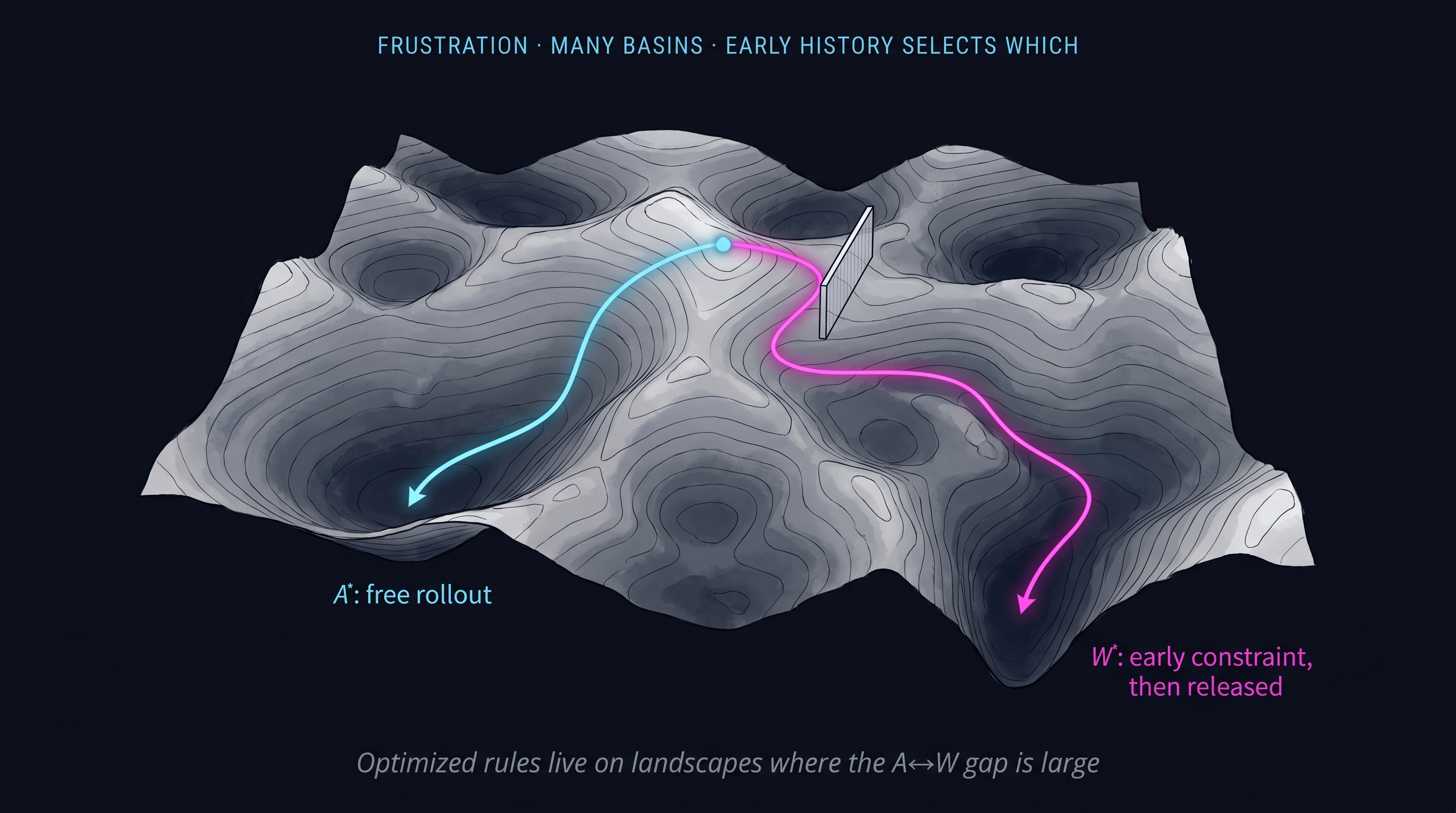
What is frustration? Put three antiferromagnetic spins on a triangle. Each pair wants to point opposite — but the three constraints cannot all be satisfied at once. The system has many local-minimum configurations of nearly equal energy, separated by barriers. This is frustration — competing local rules with no globally consistent ground state — and the result is a rugged energy landscape where the basin a system ends up in depends on its early history, not just its current state. Wolf, Katsnelson & Koonin (2018) and Vanchurin et al. (2022) argue: living matter sits in this regime.
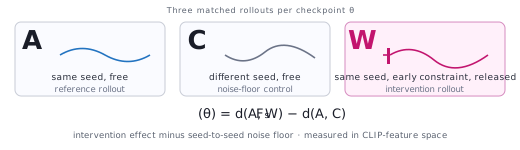
For each checkpoint $\theta$, run three matched rollouts: $A_\theta$ (same seed, free), $C_\theta$ (different seed, free), $W_\theta$ (same seed, early spatial constraint then released). The anchored frustration score subtracts ordinary seed-to-seed variability from the intervention effect, measured in CLIP-feature space:
MSPD-optimized checkpoints show larger $A \leftrightarrow W$ gaps than matched random controls — directional evidence on both substrates.
Neither result reaches conventional significance — read as underpowered evidence of history dependence rather than confirmed effect. The natural strengthening is replication with a larger matched-group ensemble, without methodological change.
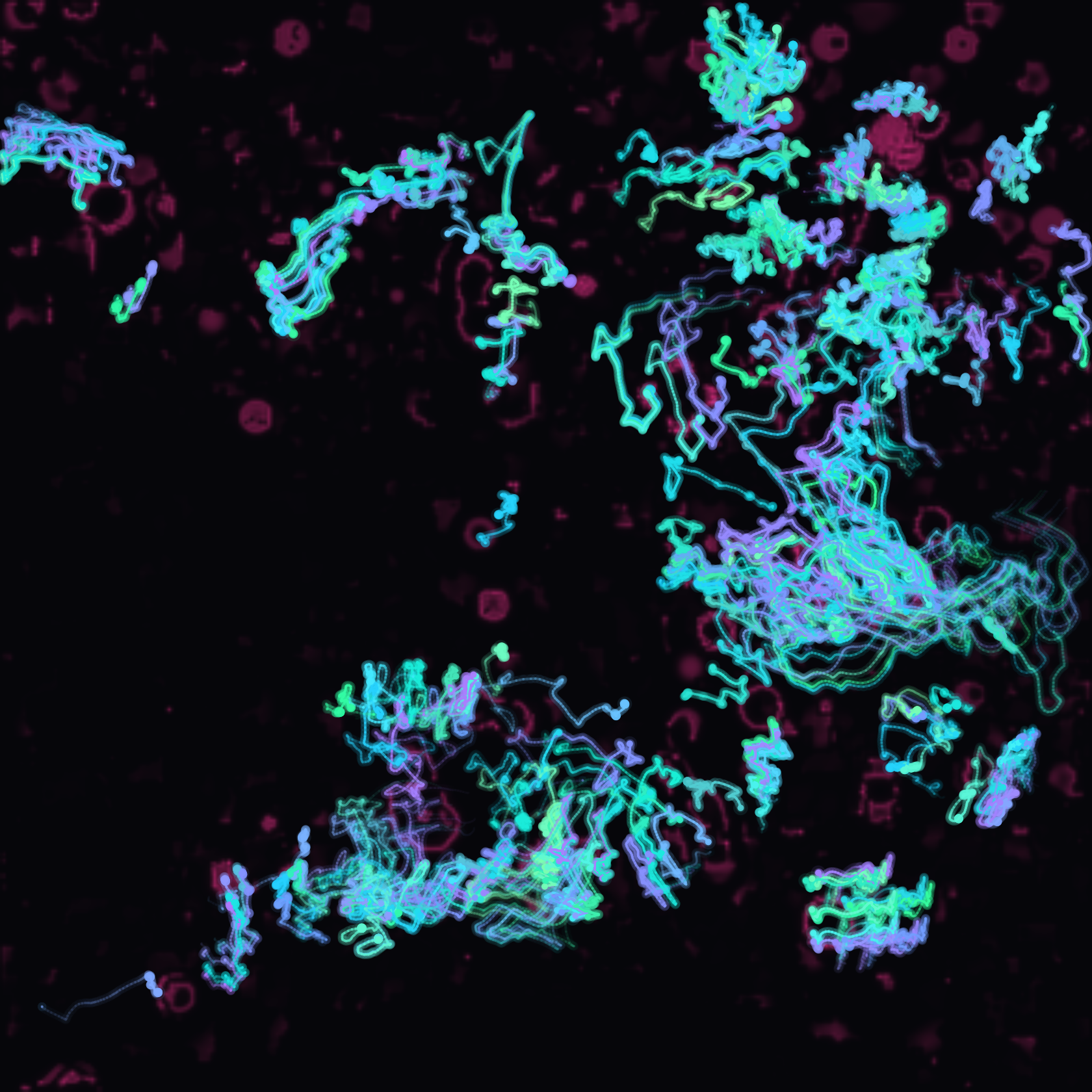
The MSPD construction applies uniformly across substrates that expose meaningful local transition laws — categorical for cellular automata, displacement for particle systems, tracer motions for Flow-Lenia. The recipe doesn't change.
| Claim | Life-CA | Flow-Lenia | Particle Life++ |
|---|---|---|---|
| C1 · MSPD-optimized $>$ random | ✓ rule sweep | ~ 6/9, p=0.25 | ✓ 7/7, p=0.008 |
| C2 · High $\Delta H$ marks branch points | ✓ | ✓ Spearman 0.62 | — |
| C5 · Scale-dependent frustration | — | ~ 7/9, p=0.09 | ~ 6/7, p=0.06 |
✓ confirmed · ~ directional / underpowered · — not run. C5 on Life-CA is straightforward to add; C2 on Particle Life++ is conceptually obstructed by the deep-attractor structure of the substrate (see paper §5.4).
We are honest about what the current evidence supports and what it doesn't. The paper's §6 limitations cover within-window stationarity, statistical power on C1/C5, sensitivity of C5 to the intervention protocol, and the incomplete 3×3 claim-substrate matrix.
Three follow-up directions are deferred to the next version of this work:
@article{akhtyrchenko_mspd_2026,
author = {Akhtyrchenko, Mikhail and
Katsnelson, Mikhail I. and
Ustyuzhanin, Andrey},
title = {{Directing Open-Ended Evolution in Artificial
Life via Multi-Scale Path Divergence}},
year = {2026},
eprint = {2606.17091},
archivePrefix = {arXiv},
url = {https://arxiv.org/abs/2606.17091}
}